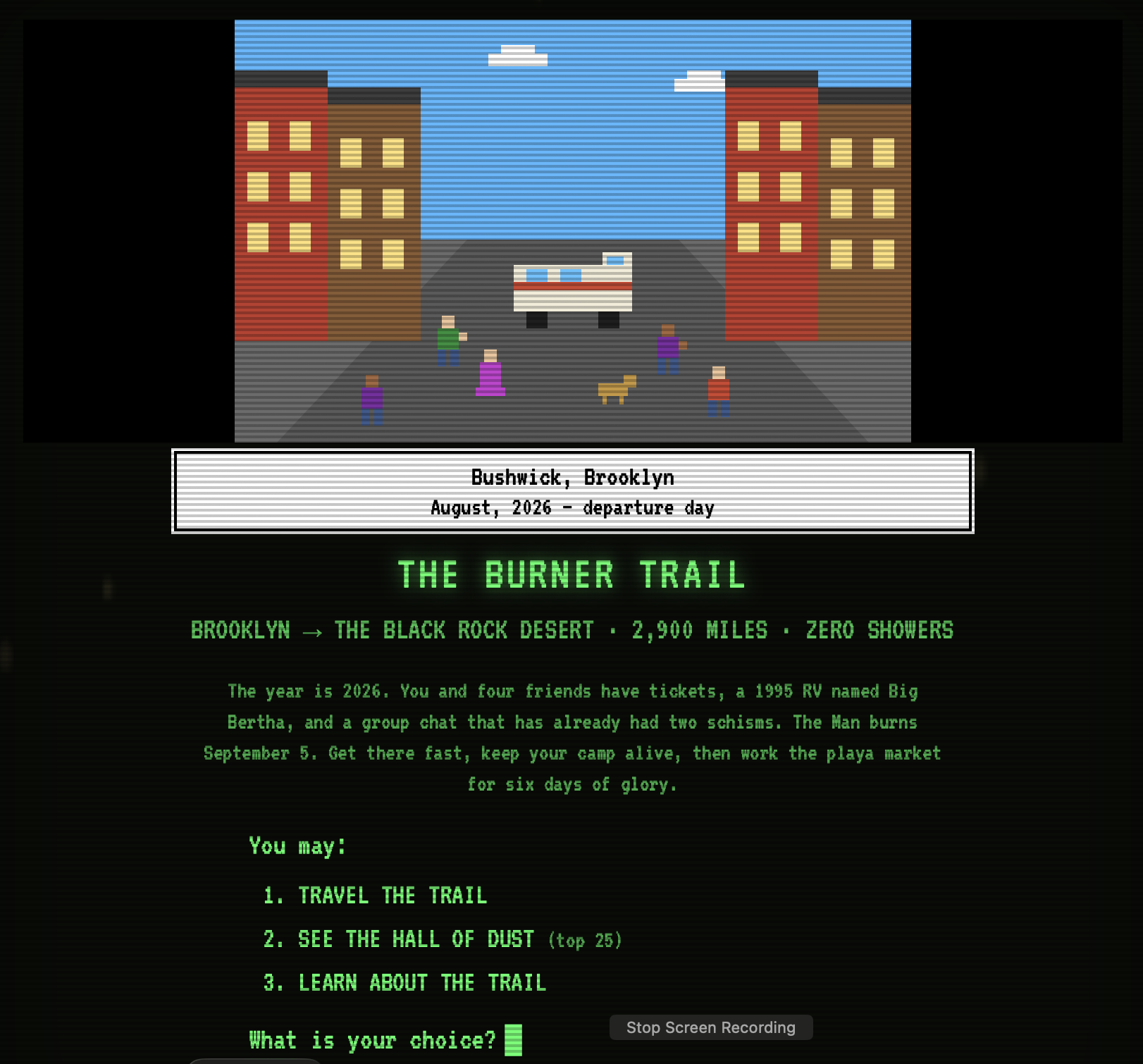
Play it at https://burnertrail.com
Brooklyn → Black Rock. 2,900 miles. Zero showers.
What happens when you take one of the most recognizable educational games of all time, replace covered wagons with a 1995 RV named Big Bertha, and send five friends across America toward Burning Man?
You get The Burner Trail — a full-stack Oregon Trail parody built for the modern desert pilgrim.
The original Oregon Trail asked players to survive a brutal journey westward through hunger, disease, bad decisions, and unpredictable weather. The Burner Trail keeps the same spirit of adventure and chaos, but swaps the frontier for a very different American migration: the annual pilgrimage from Brooklyn to Black Rock City.
The mission is simple:
Get five people, one aging RV, and enough supplies across 2,900 miles of highway before the playa market begins.
The reality is much harder.
Meet Big Bertha: Your 30-Year-Old Mechanical Liability
Every great road trip starts with a questionable vehicle.
In The Burner Trail, players take control of Big Bertha, a 1995 RV whose condition determines whether the journey becomes a triumphant arrival or a roadside disaster.
The RV has a condition meter that changes throughout the trip:
- Push too hard and breakdown risks increase.
- Ignore maintenance and repairs become inevitable.
- Run the vehicle into the ground and you may face a $300 repair bill and a two-day delay.
The game turns the classic Oregon Trail resource-management formula into something instantly familiar to anyone who has ever attempted a cross-country adventure with unreliable transportation.
A Modern Oregon Trail Built for 2026
While The Burner Trail is a parody, it is also a serious technical project.
The game was built as a complete full-stack application:
- Frontend: React 18 + Vite
- Backend: Express
- Database: SQLite with persistent Docker volumes
- Infrastructure: Terraform deployments for DigitalOcean and AWS
- Deployment: One-command cloud provisioning
A player can launch the game locally with Docker or deploy the entire application to the cloud with a single command.
The goal was not just to make a browser game, but to build a production-ready platform capable of supporting real players.
The Hall of Dust: Everyone Leaves a Mark
Death is inevitable on the trail.
But in The Burner Trail, your failure becomes part of the story.
When a player meets their fate, they can leave behind a tombstone — a digital epitaph that future travelers may discover along the route.
The game creates a shared history between players:
- Your friends can discover where you failed.
- Future travelers encounter your grave.
- Every run contributes to the growing mythology of the trail.
The leaderboard, appropriately called the HALL OF DUST, ranks every journey and immediately tells players where they stand after completing a run.
Every Choice Has Consequences
Like the original Oregon Trail, success depends on managing limited resources.
Players must balance:
- Water consumption
- Cargo weight
- RV condition
- Weather patterns
- Morale
- Travel speed
- Market timing
Even departure date matters.
Leave earlier and you have more schedule flexibility. Leave later and you risk more extreme conditions. The game forces players to make the same kind of uncomfortable tradeoffs that define real adventures.
The Fork in the Road
No road trip is complete without questionable navigation decisions.
At Chicago, players choose their route:
- The classic I-80 path
- A southern route through Denver and Moab
- A northern shortcut with greater risk
Each route changes the landmarks, weather challenges, and encounters along the way.
The game transforms interstate geography into a strategic decision rather than a background map.
From Jersey to the Playa
The journey is not just about surviving the highway.
Along the way, players encounter:
- Regional weather systems
- Scavenge opportunities
- Gift-economy caravans
- Sound-camp defections
- Supply shortages
- Random events
The final destination introduces a six-day playa market where survival continues after arrival.
Even reaching Burning Man does not mean the challenge is over.
A Retro Experience With Modern Features
Visually, The Burner Trail embraces nostalgia.
The interface features:
- CRT phosphor-inspired styling
- Typewriter text effects
- Canvas-based dust storms
- Animated environmental effects
- A shifting green-to-amber color palette as conditions deteriorate
But underneath the retro aesthetic is modern engineering.
Players can:
- Save progress through email-linked magic links
- Resume games across devices
- Share scores socially
- View rankings
- Leave persistent messages for future travelers
A Small Game With a Real Product Mindset
One of the most interesting aspects of The Burner Trail is that it was designed not only as a game, but as a potential sustainable project.
Optional monetization features include:
- Curated affiliate links for real camping gear
- Contextual recommendations based on gameplay situations
- A real-world packing list connected to in-game supplies
- Analytics designed around anonymous usage patterns
The philosophy is simple: if a player runs out of water in the game, perhaps they are interested in learning about real-world water storage. If their RV breaks down, perhaps they need camping or repair equipment.
The commercial layer stays optional and secondary to the experience.
The Spirit of the Trail
At its core, The Burner Trail is about something bigger than parody.
It captures the absurdity of modern adventure:
- Spending thousands of dollars to live without basic comforts for a week
- Driving unreliable vehicles into remote deserts
- Building elaborate temporary communities
- Trading convenience for experience
The original Oregon Trail reflected the challenges of American expansion.
The Burner Trail reflects a different kind of migration — one where people leave cities behind, chase temporary communities, and willingly trade comfort for chaos.
The destination may be Black Rock.
But the real game has always been the journey.
Welcome to the trail. Pack water. Check Big Bertha. And try not to become another name in the Hall of Dust.
Leave a Reply